


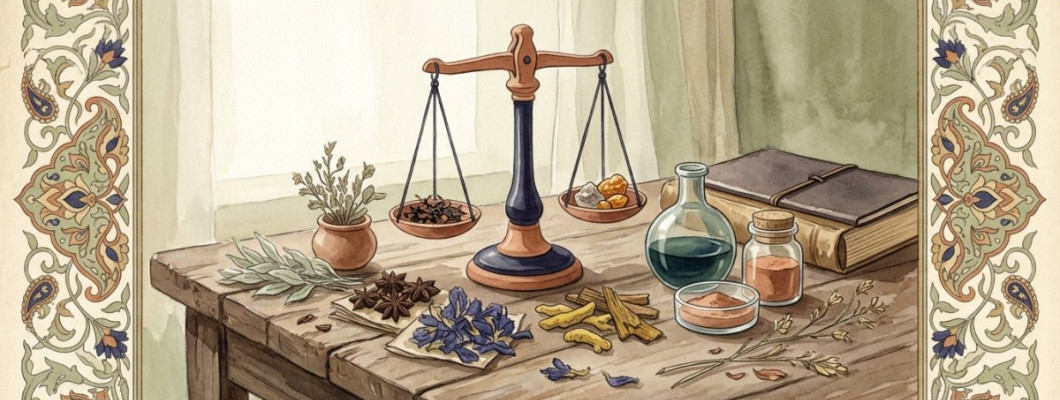
Many people often ask about the true unani vs ayurveda differences when seeking natural health paths. Both traditions hold deep respect across the Indian subcontinent and share a gentle focus on whole-body wellness. Yet, their philosophical foundations, diagnostic models, and histories are remarkably distinct from one another. [1, 2]
Today, both systems work side by side under India's Ministry of Ayush and national regulatory bodies. They use many of the same healing plants found throughout the region. However, a Unani practitioner and an Ayurvedic doctor view those plants through entirely different lenses. [1, 3]
Understanding these differences helps you appreciate the deep wisdom within each tradition. Whether you are curious about history or daily balance, learning their unique perspectives brings welcome clarity. Let us explore the origins, humours, and methods that give each system its special identity. [1, 2]
Historical Roots: Two Ancient Streams of Knowledge
The stories of these two healing traditions begin in different corners of the ancient world. Ayurveda arose thousands of years ago in ancient India as an indigenous medical tradition. It developed comprehensive ways to understand health through ancient texts and philosophical thought. [2]
In contrast, Unani medicine draws its earliest roots from ancient Greece under scholars like Hippocrates and Galen. It later flourished across the Middle East and Persia through masters such as Ibn Sina and Al-Razi. These scholars translated Greek works, added clinical observations, and refined complex medical theories. [1, 4]
Unani Tibb arrived in the Indian subcontinent around the middle of the fourteenth century during the Delhi Sultanate. Once established in India, Unani physicians embraced regional botanicals and exchanged insights with local Ayurvedic scholars. Over centuries of peaceful coexistence, both traditions grew stronger while maintaining their own theoretical principles. [1, 2]
The Geographic Journey of Unani Tibb
Because Unani traveled across Greece, Persia, and Arabia before arriving in India, it developed an international character. Scholars like Al-Razi tested drug substitutions to ensure patients could receive care even when rare herbs were missing. This rich cross-cultural history gave Unani a unique scientific and cosmopolitan literature. [1, 4]
Ayurveda as an Indigenous Heritage
Ayurveda developed directly within the Indian subcontinent over several millennia. It is rooted in deep philosophical observations of local ecology, seasons, and bodily energies. This continuous regional development created an enduring framework that remains widely practiced worldwide today. [3, 2]
The Unani Perspective: Akhlat, Mizaj, and Tabiyat
At the heart of Unani medicine lies the theory of the four humours, known in Arabic as Akhlat. These four vital fluids circulate through the body to nourish organs and sustain everyday life. They are Dam (blood), Balgham (phlegm), Safra (yellow bile), and Sauda (black bile). [1, 5]
Each humour possesses two primary qualities drawn from heat and moisture. Dam is hot and moist, while Balgham is cold and moist. In contrast, Safra is hot and dry, and Sauda is cold and dry. The unique proportion of these humours creates an individual's personal temperament, known as Mizaj. [5]
A person may have a sanguine (Damawi), phlegmatic (Balghami), choleric (Safrawi), or melancholic (Saudawi) nature. Health depends on keeping these humours balanced in quality and quantity according to your personal baseline. When this balance shifts out of harmony, Unani calls the condition Sue-Mizaj, or dystemperament. [5]
Unani relies heavily on Tabiyat, which refers to the body's innate self-preservative intelligence. A physician never forces a cure upon the body. Instead, the physician's true goal is simply to assist Tabiyat so it can restore its own balance. [1, 5]
The Four Modalities of Unani Healing
To guide Tabiyat back to equilibrium, a Unani practitioner follows four sequential stages of intervention. The physician begins with the gentlest methods before considering stronger measures. [1]
- Ilaj-bil-Tadbeer (regimental therapies such as cupping, massage, and therapeutic baths)
- Ilaj-bil-Ghiza (dietotherapy tailored to soothe the disturbed temperament)
- Ilaj-bil-Dawa (pharmacotherapy using natural herbal, mineral, or animal products)
- Ilaj-bil-Yad (surgical intervention, reserved only for specific or advanced situations)
Sources: [1]
Essential unani vs ayurveda differences at a Glance
While both systems seek harmony, they use different terms, diagnostic maps, and theoretical principles to achieve it. Reviewing these key differences helps clear up common public confusion between the two traditions. [1, 6, 2]
- Origins: Ayurveda originated in ancient India, whereas Unani began in Greece and developed in Arab and Persian lands.
- Humoral models: Ayurveda uses three Doshas (Vata, Pitta, and Kapha), while Unani relies on four Akhlat (Dam, Balgham, Safra, and Sauda).
- Constitutional types: Ayurveda identifies an individual's constitution as Prakriti, whereas Unani classifies an individual's constitution as Mizaj.
- Disease philosophy: Ayurveda views imbalance through aggravated biological energies, while Unani views illness as qualitative or quantitative humoral dystemperament (Sue-Mizaj).
- Herb classification: Ayurveda organizes botanicals by taste, attributes, potency, post-digestive effect, and special action, while Unani classifies herbs by degrees of temperature and moisture.
- Official governance: Both systems are recognized by the Indian government and overseen by the Ministry of Ayush.
Herbal Theories and Daily Balancing Methods
A fascinating aspect of traditional healing is how both systems use the same Indian plants yet explain them differently. For example, the seeds of Nigella sativa, commonly called black seed or Kalonji, appear in both systems. Both Unani and Ayurveda value this aromatic seed for digestive comfort and respiratory vitality. [7]
When an Ayurvedic practitioner studies a plant, they analyze five specific factors. These include its taste (Rasa), its physical attributes (Guna), and its heating or cooling potency (Virya). They also evaluate its post-digestive transformation (Vipaka) and any unique, inexplicable therapeutic action (Prabhava). [6]
In Unani practice, the physician evaluates an herb by its inherent degrees of temperament. Herbs are graded from the first to fourth degree in warmth, coldness, dryness, or moisture. A mild first-degree herb gently supports daily food, while a fourth-degree herb possesses potent qualities that require careful handling. [1, 6]
Daily lifestyle advice in both traditions emphasizes harmony with seasonal changes and personal constitution. Unani focuses on preserving healthy humours through balanced sleep, proper food, fresh air, and moderate physical activity. Ayurveda similarly promotes daily routines that match external weather and internal bodily energies. [1, 2]
What Modern Research Says and Its Limitations
Modern scientists are increasingly interested in the constitutional theories of traditional medicine. Preliminary human observational studies have explored biological and phenotypic markers related to Ayurvedic Prakriti and Unani Mizaj. Researchers have found intriguing variations in baseline metabolic indicators across different constitutional types. [5]
Laboratory studies have also isolated key active compounds from shared traditional herbs like Nigella sativa. Chemical analyses reveal that compounds such as thymoquinone provide noticeable antioxidant and anti-inflammatory properties in cell and animal tests. These laboratory findings offer interesting clues about how traditional botanicals might operate in living tissues. [3, 7]
Despite these encouraging early findings, significant scientific hurdles remain. There is a documented scarcity of large, multi-center human clinical trials validating classical traditional preparations. Natural herbal harvests vary widely depending on soil quality, weather conditions, and seasonal harvesting times. [1, 3]
Furthermore, traditional medicines often combine multiple herbs with strong aromas, bitter tastes, and distinct textures. These intense sensory qualities make it very difficult to design modern double-blind, placebo-controlled clinical trials. Therefore, while modern research continues to explore these ancient ideas, laboratory results should not be viewed as definitive clinical proof. [1, 2]
Frequently Asked Questions
Are Unani and Ayurveda the same system of medicine?
No, they are distinct systems with different origins and philosophies. Ayurveda developed in ancient India around three Doshas, while Unani developed in Greece and the Middle East around four humours (Akhlat). [1, 2]
Can Unani and Ayurvedic practitioners use the same medicinal plants?
Yes, both traditions share many native plants such as Nigella sativa. However, they evaluate and combine them differently based on their own unique pharmacopoeial rules. [6, 7]
What does Mizaj mean in Unani medicine?
Mizaj means temperament. It reflects the unique balance of the four bodily humours (blood, phlegm, yellow bile, and black bile) within an individual. [5]
Are Unani medicines legally recognized and regulated in India?
Yes, Unani medicine is fully recognized and regulated by the Government of India under the Ministry of Ayush and the National Commission for Indian System of Medicine. [1]
How does Unani view the body's natural ability to heal?
Unani places supreme trust in Tabiyat, the body's innate self-preservative intelligence. All Unani therapies are designed to assist Tabiyat in restoring internal harmony. [1, 5]
Conclusion
Both Unani and Ayurveda offer time-tested frameworks for viewing the human body as an integrated whole. While Ayurveda understands health through the balance of the three Doshas, Unani restores vitality by nurturing the four Akhlat and supporting Tabiyat. [1, 5, 2]
Appreciating the clear differences between these systems enriches our understanding of traditional healthcare. By exploring their unique histories and methods, you can make informed decisions that honor your personal path to balanced living. [1, 2]
Further Reading on The Hekim
- Unani Medicine vs. Modern Healthcare
- The Ultimate Guide to Unani Medicine: Balance and Healing
- Unani Medicine: Ancient Wisdom and Natural Healing
References
- Concepts and Quality Considerations in Unani System of Medicine.. Parveen A, Parveen R, Akhatar A et al.. Journal of AOAC International, 2020. PMID 31547901. DOI: 10.5740/jaoacint.19-0284 (Checked 2026-11-04)
- A glimpse of Ayurveda - The forgotten history and principles of Indian traditional medicine.. Jaiswal YS, Williams LL. Journal of traditional and complementary medicine, 2017. PMID 28053888. DOI: 10.1016/j.jtcme.2016.02.002 (Checked 2026-11-04)
- The Traditional Medicine and Modern Medicine from Natural Products.. Yuan H, Ma Q, Ye L et al.. Molecules (Basel, Switzerland), 2016. PMID 27136524. DOI: 10.3390/molecules21050559 (Checked 2026-11-04)
- Unani concept of drug substitution (therapeutic interchange) and its validation on scientific parameters - PMC. pmc.ncbi.nlm.nih.gov (Checked 2026-11-04)
- A scientific correlation between dystemprament in Unani medicine and diseases: a systematic review - PMC. pmc.ncbi.nlm.nih.gov (Checked 2026-11-04)
- Translating Ayurvedic concepts to modern drug structures: A novel paradigm - PMC. pmc.ncbi.nlm.nih.gov (Checked 2026-11-04)
- A review on therapeutic potential of Nigella sativa: A miracle herb.. Ahmad A, Husain A, Mujeeb M et al.. Asian Pacific journal of tropical biomedicine, 2013. PMID 23646296. DOI: 10.1016/S2221-1691(13)60075-1 (Checked 2026-11-04)
Medical Disclaimer
This article is for general education about Unani medicine and traditional wellness. It is not medical advice, diagnosis or treatment. Traditional uses described here are not proof that a remedy works for any disease. Please consult a qualified Unani physician (Hakim) or your doctor before starting any remedy, especially if you are pregnant, breastfeeding, taking other medicines or have a medical condition.

टिप्पणी लिखें